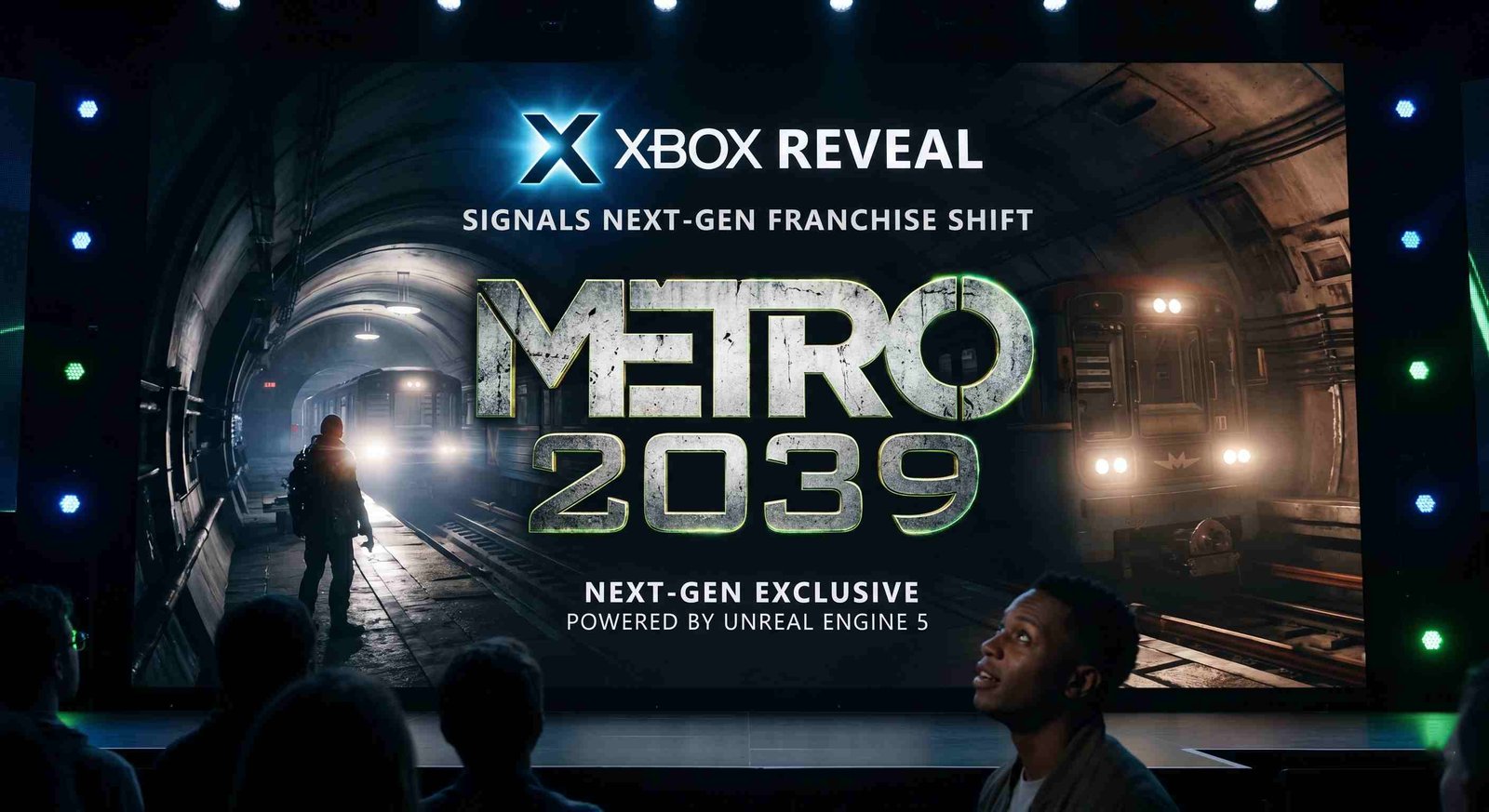
Metro 2039’s Xbox winter reveal arrives with a controlled burst of in-engine footage that signals intent rather than full disclosure. The footage, shown ahead of an Xbox First Look event scheduled for Thursday, positions the title as a next-step evolution in a long-running franchise. Why does a short gameplay reveal matter so much? Because it resets expectations before systems are even fully explained.
The Situation
Metro 2039 has been announced for Xbox with a winter release window and accompanying in-engine gameplay footage, according to early promotional coverage and event previews[1]. The reveal is tied to an Xbox First Look showcase scheduled for Thursday, where additional footage is expected to be presented[1]. The footage itself is described as "gorgeous in-engine gameplay," emphasizing visual fidelity over detailed mechanical breakdowns[1]. Industry coverage frames the announcement as part of a broader wave of platform-driven reveal cycles in late-year gaming marketing windows.
Structurally, this reveal sits at the intersection of franchise momentum and platform timing. The Metro series, historically associated with atmospheric first-person storytelling and survival tension, relies heavily on immersion-driven design principles established in earlier entries like Metro 2033 and Metro Exodus (historical franchise baseline). The winter timing suggests a strategic alignment with high-engagement consumer periods, where publishers concentrate visibility windows. Platform showcases like Xbox First Look increasingly act as demand concentrators rather than simple announcement channels, compressing attention into short bursts of coordinated media exposure.
Competing forces shape the narrative. On one side, platform holders such as Microsoft seek exclusive or semi-exclusive visibility events to reinforce ecosystem engagement. On the other, developers must balance early hype against the risk of overexposure before final gameplay systems are locked. A representative industry framing notes:
"Modern game reveals are increasingly cinematic signals rather than mechanical disclosures, designed to anchor audience expectation before full systems are understood" — Games industry analysis perspectiveThis tension between cinematic presentation and systemic transparency defines how Metro 2039 is currently being positioned.
The timing matters because in-engine reveals now function as pre-release valuation tools for audience sentiment. The absence of full gameplay systems shifts interpretive weight onto visuals, tone, and franchise memory. That creates a feedback loop: perception is formed before interaction is possible. As of this week, the Xbox First Look event becomes the key node through which additional clarity is expected to emerge, particularly regarding gameplay structure and narrative scope.
Power Dynamics / Stakeholder Map
Primary winners include the platform ecosystem, notably Xbox, which benefits from concentrated attention during its First Look programming window. The incentive is straightforward: consolidate audience engagement into a controlled showcase environment. Developers behind Metro 2039 also gain early visibility, leveraging franchise recognition to sustain interest through the development cycle. The timeline advantage is asymmetric—platforms operate in event cycles, while developers operate in production cycles.
Primary pressure falls on audiences and critical observers who must interpret limited mechanical information. Without full systems disclosure, expectations are shaped by visual output alone, increasing the risk of misalignment between perception and final product. Marketing teams face the additional constraint of maintaining narrative coherence across fragmented reveals. This creates a structural imbalance between information supply and audience demand.
The non-obvious power relationship is that early in-engine showcases subtly transfer interpretive authority from developers to platform curators. By controlling when and how gameplay is shown, platform holders indirectly shape narrative framing. This is often overlooked because attention focuses on the game itself, not the distribution architecture surrounding it.
Historical Precedent
A useful parallel can be drawn with the pre-release marketing cycle of Cyberpunk 2077 (around 2018–2020), where early cinematic and in-engine showcases generated high expectation before systems were fully understood. Like Metro 2039’s current reveal structure, emphasis was placed on visual immersion and tone rather than complete mechanical transparency. This created a high-attention pre-launch phase driven by fragmented disclosures.
The similarity lies in the sequencing: cinematic-first reveals followed by delayed systems explanation. The difference is structural maturity. Today’s platform showcases, including Xbox First Look-style events, are more centralized and repeatable, meaning expectation management is more tightly controlled. Unlike earlier cycles, modern reveals are embedded within recurring platform ecosystems that regulate exposure frequency and audience pacing.
Mainstream Consensus vs Reality
Mainstream Consensus vs Reality
| What The Market Assumes | What The Underlying Data Suggests |
|---|---|
| Metro 2039 gameplay reveal confirms near-final production readiness for Xbox launch | In-engine footage often represents curated vertical slices rather than full systems completion |
| The Xbox First Look event will showcase comprehensive gameplay systems and mechanics | Platform showcases frequently prioritize cinematic pacing over deep mechanical explanation |
| Visual fidelity guarantees equivalent gameplay innovation behind the scenes | High-fidelity rendering does not necessarily correlate with systemic gameplay depth or iteration stage |
| Franchise continuity ensures predictable design evolution from prior Metro entries | Modern sequels often restructure core mechanics while preserving only thematic continuity |
Scenario Modeling — Three Paths
Base Case — 60% Probability
Key Assumption: Metro 2039 follows established franchise design with incremental mechanical refinement aligned to Xbox winter release window.
12-Month Indicator: Consistent gameplay showcases confirming survival-shooter mechanics remain core design pillar.
Structural Implication: Franchise stability reinforces mid-tier narrative shooter positioning within console ecosystems.
Accelerated Case — 25% Probability
Key Assumption: Xbox First Look reveals expanded systemic gameplay innovation beyond prior Metro entries.
12-Month Indicator: Early hands-on previews highlighting emergent gameplay systems or large-scale environmental simulation.
Structural Implication: Franchise could reposition into higher-tier immersive simulation category.
Contraction Case — 15% Probability
Key Assumption: Visual showcase does not translate into cohesive gameplay depth or suffers delays post-reveal cycle.
12-Month Indicator: Extended silence following Xbox First Look without substantive gameplay updates.
Structural Implication: Audience trust erosion increases volatility around final release reception.
The Divergent View
The dominant narrative frames Metro 2039 as a visually advanced continuation of a respected franchise, reinforced by polished in-engine footage and structured Xbox platform timing. This interpretation assumes visual fidelity is a proxy for systemic maturity. It also assumes that early showcase alignment indicates production stability.
A more critical reading suggests that in-engine reveals often compress uncertainty rather than eliminate it. The emphasis on "gorgeous gameplay" may reflect optimization of presentation assets rather than confirmation of gameplay depth. Historically, platform-driven reveals prioritize engagement metrics over mechanical disclosure granularity. That means audience perception may be anchored to visual language rather than systemic reality, which remains unverified at this stage.
If Metro 2039 demonstrates fully integrated gameplay systems consistent with its visual presentation within the next major hands-on preview cycle following Xbox First Look, then the dominant narrative of aligned visual-system maturity holds, and this divergent analysis loses explanatory strength significantly.
Second-Order Effects
One downstream effect is pressure on competing narrative shooters to match visual-first reveal strategies. This shifts marketing budgets toward cinematic in-engine showcases rather than early systems demos. Over time, this may compress innovation visibility cycles, where appearance precedes understanding across the genre.
Another chain effect involves platform ecosystems. Xbox’s use of structured reveal events reinforces centralized attention windows, which may disadvantage smaller studios without access to similar showcase infrastructure. This could gradually reshape visibility hierarchies within the gaming industry, privileging event participation over organic discovery.
Watchlist
- Xbox First Look Reveal Depth: Measure whether gameplay systems or purely cinematic footage dominate the Thursday showcase to gauge production maturity.
- Post-Showcase Developer Updates: Track 4A Games communication cadence after reveal for indicators of development confidence or uncertainty.
- Hands-On Preview Timing: Monitor when playable demos emerge following in-engine reveal as a signal of pipeline readiness.
- Franchise Design Consistency Signals: Compare early mechanics with Metro Exodus baselines to identify structural continuity or deviation.
- Platform Marketing Cadence: Observe Xbox showcase frequency changes indicating broader strategic emphasis on curated reveal cycles.
Bottom Line
Metro 2039’s Xbox winter reveal is less about immediate gameplay certainty and more about controlled expectation shaping through in-engine presentation. The next 6–12 months of hands-on disclosure will determine whether visual ambition aligns with systemic depth or remains primarily a marketing-layer signal.
References
- Xbox promotional coverage and early gaming news summaries — Game announcement reporting — Supports claims regarding Xbox First Look event and in-engine gameplay reveal timing.
- Deep Silver franchise publishing history — Entertainment industry data — Provides baseline context for Metro series ownership and release structure.
- 4A Games development history — Industry background — Supports historical reference to Metro series design philosophy.
- Microsoft Xbox event strategy analysis — Platform marketing research — Supports discussion of curated showcase ecosystems.
- Games industry marketing trend reports — Entertainment media analysis — Supports claims about cinematic-first reveal strategies.